
.svg)

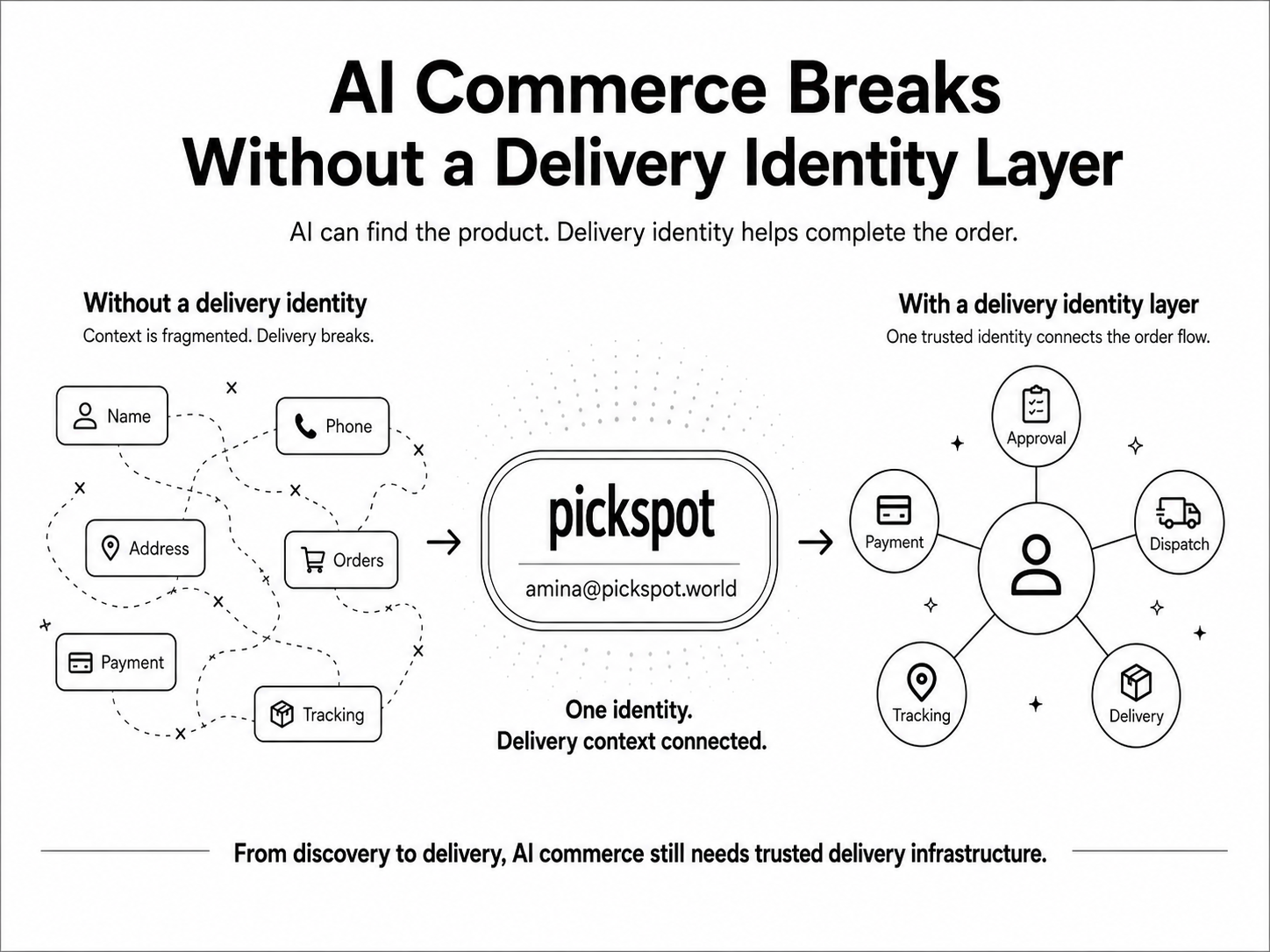
This post explains why AI commerce still needs delivery identity. AI agents may help customers discover, compare, and buy products, but orders still need saved addresses, customer approval, safe payment, rider coordination, tracking, and handoff confirmation. PickSpot gives AI-driven commerce the infrastructure to move from recommendation to real delivery.
AI agents are changing how people shop.
Soon, you may not search through ten websites yourself.
You may ask an AI agent:
“Find me the best running shoes under KES 8,000.”
Or:
“Order the same skincare product I bought last time.”
Or:
“Find this dress on Instagram and get it delivered.”
The AI can search.
It can compare.
It can recommend.
It can help you decide.
It may even help start the order.
But then commerce hits the same old question:
Where should it be sent?
Delivery is personal.
Your home address matters.
Your apartment details matter.
Your phone number matters.
Your delivery instructions matter.
Your safety matters.
Your approval matters.
An AI agent should not casually expose your private address to every seller.
It should not send payment without your approval.
It should not coordinate delivery through random chat messages, screenshots, and pins.
It needs a trusted delivery identity it can use when you decide to buy.
That is where PickSpot comes in.
AI can make shopping smarter.
But intelligence alone does not complete the order.
The order still needs structure.
Who is the buyer?
Where should the order go?
Has the customer approved the total cost?
Has payment been collected?
Who is picking up from the seller?
Can the customer track the delivery?
How is handoff confirmed?
When does the seller get paid?
Without that structure, AI commerce becomes another front end sitting on top of a broken delivery process.
The AI may find the product.
But the buyer still ends up sending pins, landmarks, screenshots, and payment confirmations in chat.
That is not the future of commerce.
A PickSpot is a private delivery identity.
Something like:
The customer saves their delivery address inside PickSpot.
When they want to buy from a seller, they share their PickSpot instead of sending their full address manually.
The seller uses that PickSpot in PickSend to send an order request.
The customer reviews the product amount, delivery fee, and total cost.
The customer approves and pays.
PickSpot coordinates the rider.
The rider picks up from the seller and delivers to the customer’s saved address.
The customer tracks delivery and confirms handoff.
The seller gets paid after successful delivery.
That same identity layer becomes even more important when AI agents start helping people buy.
The future is not an AI agent randomly buying things and sending them anywhere.
The future needs permission.
The customer should still approve the order.
The customer should still see the cost.
The customer should still control where delivery goes.
The customer should still know when payment is made.
The customer should still be able to track and confirm handoff.
PickSpot gives that process a structure.
The AI can help find the product.
PickSpot can help make the order safe enough to complete.
Traditional addresses were built for forms.
AI commerce will not always happen inside forms.
It may happen inside chat.
Inside voice.
Inside search.
Inside social platforms.
Inside AI assistants.
Inside product recommendations.
But no matter where the order starts, the system still needs a way to know where the order should go.
A delivery identity solves that better than repeatedly typing a full address into every new channel.
Instead of exposing private details everywhere, the customer can use one handle.
Send it to my PickSpot.
That is a much cleaner instruction for humans.
It is also a much cleaner instruction for software.
Closed platforms already know where to send your order because they own the account, checkout, address book, payment flow, and delivery layer.
But open commerce is different.
A product may be discovered on TikTok.
The seller may close through WhatsApp.
The payment may happen through mobile money.
The delivery may be handled by a rider network.
The customer may not want the seller to manually collect their private address.
AI makes this even more complex.
More products.
More sellers.
More channels.
More transactions starting outside traditional checkouts.
That world needs a standard delivery identity.
Not another marketplace.
A layer that can connect the buyer, seller, payment, dispatch, tracking, and handoff.
That is PickSpot.
The more AI helps people buy, the more important trust becomes.
Customers will need to know:
What am I buying?
Who is the seller?
What am I paying?
Where is it being delivered?
Can I track it?
How is handoff confirmed?
Sellers will need to know:
Is this a real customer?
Has the customer approved the order?
Has payment been collected?
Who is coordinating pickup?
When will I get paid?
PickSpot gives both sides a safer structure.
The AI may create demand.
PickSpot helps complete the transaction.
To your PickSpot.
Not because PickSpot is just an address.
Because PickSpot is the delivery identity that connects the order to your saved address, your approval, your payment, the rider, the tracking, the handoff, and the seller payout.
AI can make commerce faster.
But faster commerce still needs safe delivery.
That is why AI agents need delivery identity.