
.svg)

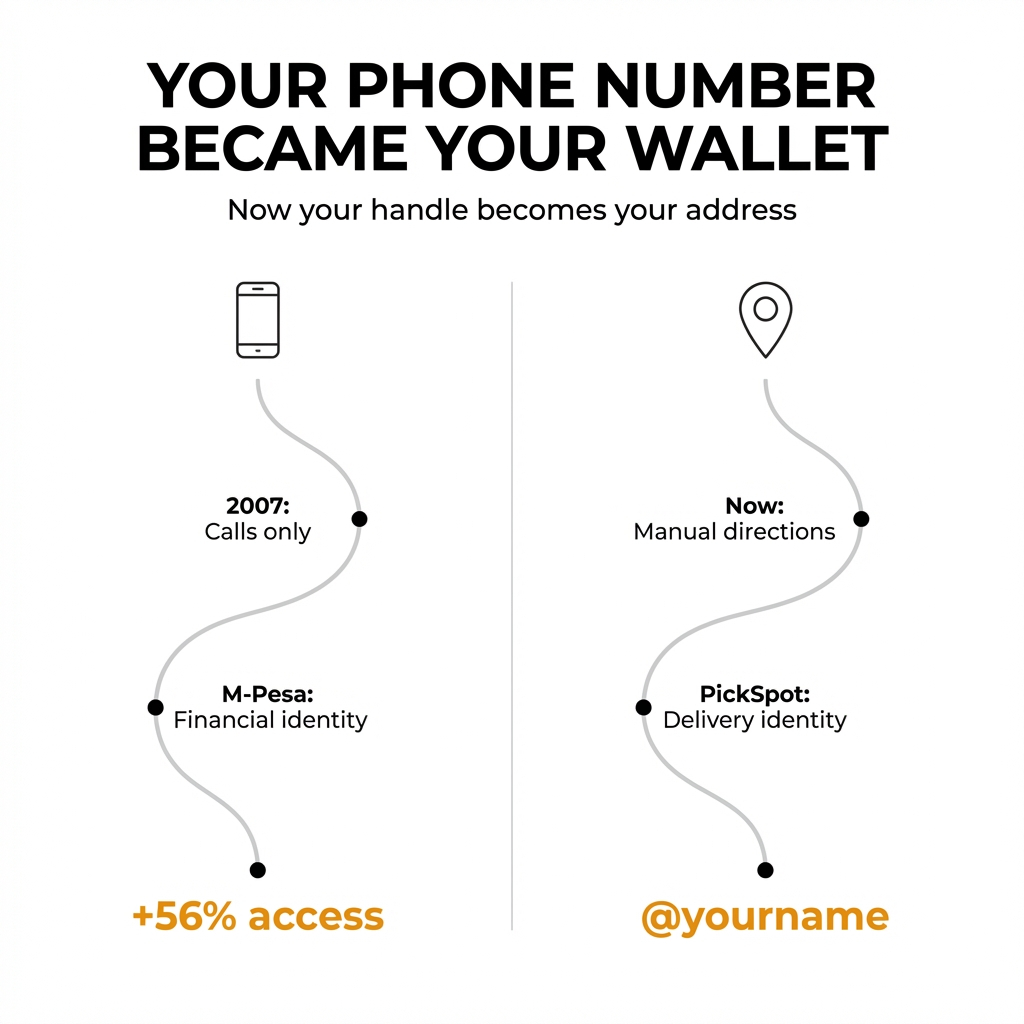
Phone numbers started as contact identifiers. M-Pesa turned them into addresses for money. The number stayed the same. The function changed.After M-Pesa, sending money required one piece of...
Phone numbers started as contact identifiers.
Then M-Pesa changed what they meant.
A phone number stopped being only a way to call someone. It became a way to send them money.
No bank branch.
No account number.
No long explanation.
Just a phone number.
The number routed the transaction.
PickSpot is doing something similar for delivery.
Your handle starts as an identifier.
Something like:
But in commerce, that handle becomes much more important.
It becomes your delivery identity.
Before mobile money became normal, sending money required more coordination.
You needed bank details.
You needed account numbers.
You needed branch information.
You needed to trust that you had the right recipient.
Then mobile money made the process simple.
You asked:
“What’s your M-Pesa?”
The answer was a phone number.
That number became enough to route money.
It did not matter where the person lived.
It did not matter where they were standing.
It did not require a full explanation every time.
The phone number became portable financial infrastructure.
Delivery has not had the same moment.
When someone wants to send you an order, they still ask:
“Where are you located?”
Then the same messy process starts again.
You send a pin.
Then a landmark.
Then your building name.
Then your phone number.
Then extra directions.
Then the rider calls anyway.
The next seller asks the same question.
And you explain everything again.
That is strange when you think about it.
Payments became reusable.
But delivery is still rebuilt manually every time.
A PickSpot handle gives delivery the reusable identity layer it has been missing.
Instead of sharing your home address in every chat, you share your PickSpot.
Example:
Inside PickSpot, your handle is connected to your saved delivery details.
When you buy from a seller, the seller uses your PickSpot to send you an order request through PickSend.
You review the request.
You approve the price and delivery fee.
You pay safely.
PickSpot coordinates the rider.
The item is collected from the seller.
The order is delivered to your saved address.
You track the delivery.
You confirm handoff.
The seller gets paid after successful delivery.
That is the real shift.
Your PickSpot is not just a shorter address.
It is the identity that starts a safer order flow.
A phone number lets someone send you money without knowing your bank account.
A PickSpot lets a seller send you an order without manually collecting your private address in chat.
The seller does not need your gate code in WhatsApp.
They do not need a voice note explaining where you live.
They do not need to manage your address manually.
They only need your PickSpot.
PickSpot privately connects the order to your saved delivery details and coordinates the delivery flow.
That makes the process simpler for the seller and safer for the customer.
This is what makes identity powerful.
Your bank may change.
Your SIM provider may change.
Your phone may change.
But the number can remain the way people reach you.
Delivery needs the same pattern.
Your home address may change.
Your office may change.
Your preferred delivery details may change.
Your building instructions may change.
But your PickSpot can stay the same.
The seller should not have to relearn your delivery details every time.
They should only need your delivery identity.
Social commerce already has discovery.
Instagram shows the product.
TikTok creates demand.
WhatsApp closes the conversation.
Mobile money moves funds.
Riders move parcels.
But the order still breaks at the same point:
Who takes the first risk?
The buyer does not want to pay blindly.
The seller does not want to send before payment.
The rider needs clear delivery instructions.
PickSpot connects these pieces.
The handle identifies the buyer.
The order request structures the transaction.
Payment happens before dispatch.
Delivery is coordinated.
Handoff is confirmed.
The seller is paid after successful delivery.
That is why the handle matters.
It is not only an address.
It is commerce infrastructure.
M-Pesa made one question normal:
“What’s your M-Pesa?”
PickSpot wants to make the next question normal:
“What’s your PickSpot?”
Because commerce should not need a paragraph to deliver an order.
It should not need a stranger to know your private address.
It should not depend on blind payment and manual rider coordination.
It should start with one identity.
One handle.
One safe order flow.
That is what your PickSpot becomes.