
.svg)

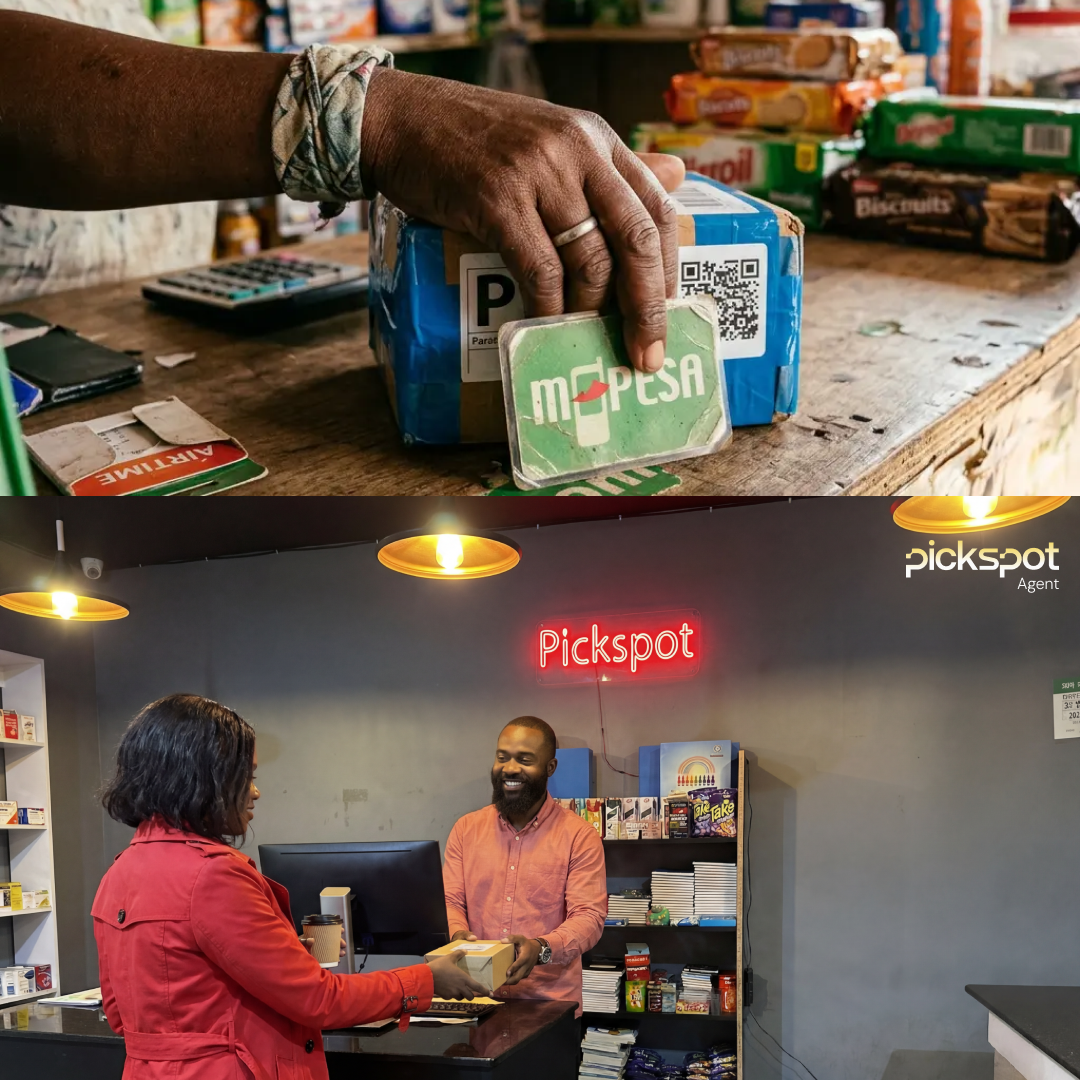
In 2007, Safaricom didn't build thousands of bank branches.They walked into existing shops — airtime dealers, mini-marts, kiosks — and said: you already have a counter and customers who trust you....
In 2007, Safaricom didn't build thousands of bank branches.
They walked into existing shops — airtime dealers, mini-marts, kiosks — and said: you already have a counter and customers who trust you. Now you can also move money.
Those shops became M-Pesa agents. M-Pesa agents became the financial infrastructure of an entire country.
No one built a new building. The infrastructure was already there. It just needed activation.
Delivery in Kenya is waiting for the same moment.
Before M-Pesa, sending money to someone in another town meant getting the physical cash on a bus. You'd hand cash to a bus driver and hope it arrived.
The system worked — kind of. But it didn't scale. It depended on knowing the right person, at the right time, going to the right place.
That's delivery in Nairobi today.
A seller on Instagram closes a sale in the DMs. Then spends 20 minutes explaining where the buyer lives. The rider calls twice. Drives past the building. Calls again. The buyer isn't home. Package goes back.
We moved money from handshakes to infrastructure. Delivery is stuck in the handshake era.
M-Pesa didn't try to do everything. They didn't build branches. They didn't manufacture ATMs. They didn't create a new type of shop.
They looked at what already existed — thousands of small businesses in every neighborhood in Kenya — and gave them one new capability.
Accept and release money.
The genius was in what they didn't build. The shops were already trusted. Already located where people lived. Already open during working hours. M-Pesa just gave them a reason to handle one more thing.
Within a few years, M-Pesa agents outnumbered bank branches in Kenya by more than 100 to 1.
PickSpot isn't building warehouses. We're not buying delivery trucks. We're not asking anyone to change how they run their business.
We're walking into shops that already exist and saying: you already have the counter, the shelf, the staff, and the trust. Now you can also handle parcels.
A PickSpot Agent receives deliveries on behalf of people nearby. Stores them safely. Hands them over when the customer walks in with a QR code and a one-time PIN.
Receive. Store. Release. Earn.
The parcel operation sits on top of whatever that shop already does. A corner shop is still a corner shop. A pharmacy is still a pharmacy. They just also happen to be the place where the neighborhood picks up packages.
M-Pesa turned shops into banks. Uber turned car owners into taxi drivers. Airbnb turned apartments into hotels.
None of them built new physical infrastructure from scratch. They activated what was already there.
Kenya has over 200,000 M-Pesa agent locations. Not because Safaricom built 200,000 outlets. Because 200,000 shop owners saw an opportunity and raised their hand.
PickSpot is starting the same way.
One neighborhood at a time. One shop at a time. Each agent that goes live makes the network stronger, makes delivery more reliable, and makes the next agent more valuable.
Social commerce in Africa is exploding. People are buying and selling on WhatsApp, Instagram, and TikTok every single day.
The money moves instantly — Mobile money made sure of that.
But the goods still don't. Because there's no infrastructure for the last 500 meters.
That's the gap. Money has rails. Delivery doesn't. Not yet.
PickSpot Agents are those rails.
A fixed location. Consistent hours. A trusted face behind the counter. Secure storage.
These are the same things that made M-Pesa agents work. And they're exactly what makes a PickSpot Agent work.
If your shop handled mobile money when M-Pesa launched, you already understand the model. The product is different. The mechanics are the same.
And the opportunity for early movers is identical.
M-Pesa didn't launch nationwide on day one. They started in specific neighborhoods. Built density. Proved the model worked. Then expanded.
PickSpot follows the same rollout pattern.
When three shops in a neighborhood become PickSpot Agents, buyers in that area gain a reliable pickup option. Sellers start offering PickSpot as a delivery method because it works. More transactions happen. More parcels flow through those agents. Revenue increases.
That density attracts more agents. More agents create more coverage. More coverage makes PickSpot the default option for social commerce deliveries in that area.
The network compounds neighborhood by neighborhood.
The operational model is simple.
A buyer completes a purchase on Instagram or WhatsApp. The seller ships the parcel to the nearest PickSpot Agent. The agent receives it, scans the QR code, and stores it securely.
The buyer gets a notification with a QR code and a one-time PIN. They walk to the agent location. Show the code. Verify with the PIN. Collect the parcel.
The agent earns a fee for each parcel handled. No upfront cost. No inventory risk. No complex training required.
The shop continues operating as it always has. The parcel handling happens in the gaps — between customer transactions, during slower hours, as part of the existing workflow.
M-Pesa agents didn't join because they loved financial technology. They joined because it brought foot traffic and created a new revenue stream.
PickSpot Agents join for the same reasons.
Every parcel pickup brings a customer into the shop. That customer might buy airtime. Might grab a snack. Might browse products they didn't plan to purchase. The parcel becomes the reason to visit. The shop visit creates additional sales.
The fee structure is straightforward. Agents earn per parcel. Volume increases earnings. There's no cap, no quota, no penalty for slow days.
Shops that become agents early gain positioning as the neighborhood pickup point. That positioning becomes harder to displace as customers form habits around that location.
Home delivery in Nairobi has a reliability problem.
Addresses are informal. Buildings lack clear numbering. Riders get lost. Buyers miss calls. Deliveries fail. Packages return to sender. The transaction dies.
Pickup points solve the address problem by replacing it with a location problem. The buyer doesn't need to explain where they live. They just need to walk to a shop they already know.
The parcel waits there. Securely. Until they're ready to collect it.
No failed delivery. No missed calls. No explaining directions three times. The friction disappears.
Sellers on Instagram and WhatsApp lose money on failed deliveries.
They pay the rider. The delivery fails. They refund the buyer or reship. The margin evaporates. The transaction becomes unprofitable.
PickSpot changes the success rate. The parcel reaches the agent. The agent confirms receipt. The buyer collects it when convenient. The delivery completes.
Sellers stop losing money on failed attempts. Buyers stop abandoning purchases because delivery feels unreliable. Transaction completion rates increase.
That reliability creates repeat behavior. The second purchase happens faster because the delivery method already worked. The third purchase happens without hesitation.
E-commerce platforms in Kenya have warehouses and logistics networks. But social commerce doesn't run through those platforms.
Social commerce happens in DMs. In WhatsApp groups. In Instagram comments. The transaction is peer-to-peer. The payment is M-Pesa. The delivery is... improvised.
That's the missing layer. Social commerce solved discovery and payment. It didn't solve delivery.
PickSpot is that layer. The addressing system for transactions that happen outside traditional e-commerce platforms.
Shop owners didn't wait for Bank's to open branches in their neighborhood. They became MOMO agents and brought financial services to their customers themselves.
Delivery won't wait either.
The shops that step in now become the delivery network. The ones that wait will watch the network form without them.
MOMO proved that distributed infrastructure beats centralized infrastructure in emerging markets. PickSpot applies that proof to parcels.
M-Pesa became the default way to move money in Kenya. Not because Safaricom mandated it. Because the agent network reached the point where using M-Pesa was easier than not using it.
PickSpot is moving toward the same tipping point.
When enough agents go live in a neighborhood, PickSpot becomes the expected delivery option. Sellers offer it by default. Buyers request it. The handle becomes as standard as an M-Pesa number.
That's when the infrastructure becomes foundational. When other systems start building on top of it. When the network stops being an alternative and becomes the standard.
M-Pesa agents who joined early became the financial anchor of their neighborhoods. They handled the most transactions. Built the most customer trust. Earned the most fees.
The same dynamic applies to PickSpot.
The shops that become agents now gain positioning before the network saturates. They become the known pickup point. The place customers default to. The location that captures the majority of parcel volume in that area.
Waiting means watching someone else claim that position.
If your shop handled mobile money when M-Pesa launched, you already understand this model.
If you're located where people live and shop, you're positioned to become a PickSpot Agent.
The setup is simple. The operations are straightforward. The revenue is per-parcel. The network is growing.
Kenya didn't wait for banks to reach every village. Shop owners stepped in and became the financial network.
Delivery won't wait either. The shops that step in now become the delivery network.