
.svg)

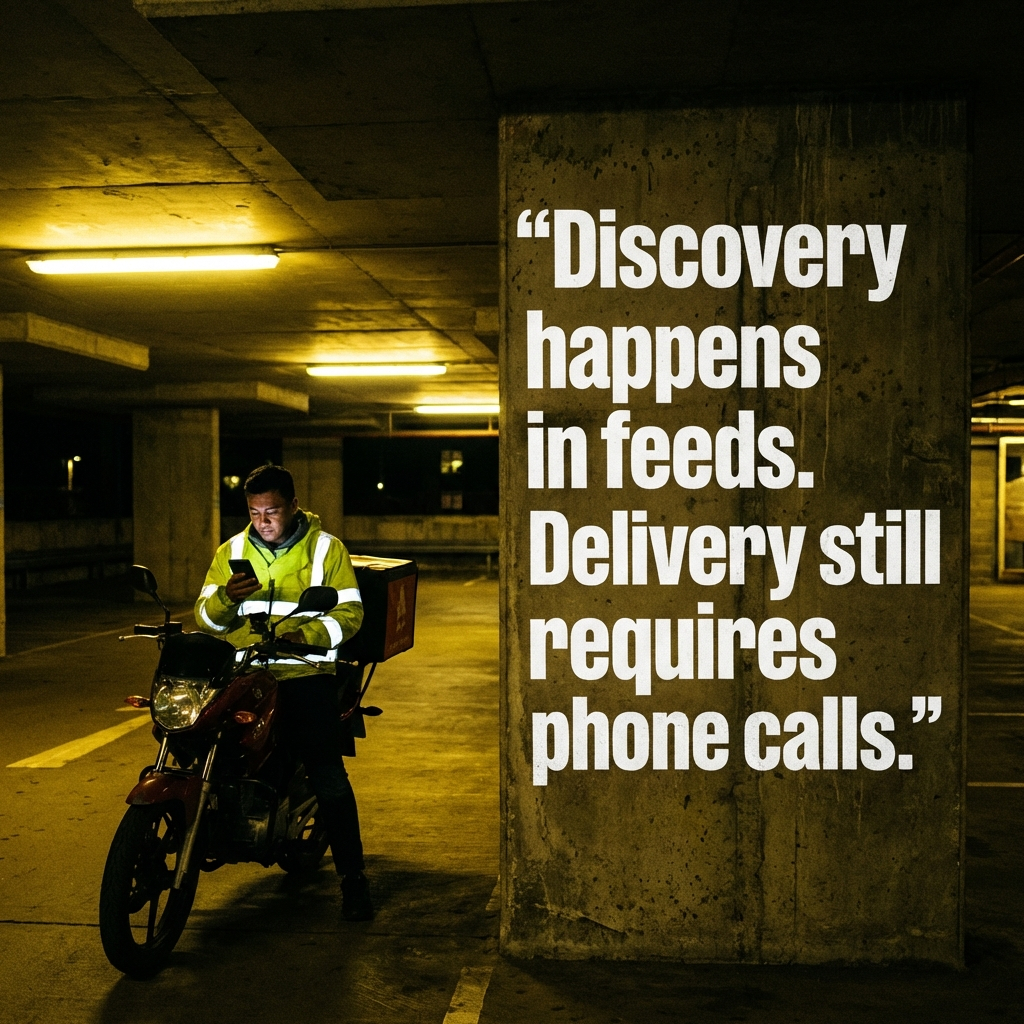
This post explains that social commerce has already solved discovery through Instagram, TikTok, and WhatsApp, but delivery still breaks after the buyer decides to purchase. PickSpot solves the missing layer by turning a risky chat order into a structured flow with delivery identity, order approval, safe payment, rider coordination, tracking, handoff confirmation, and merchant payout.
Social commerce already won discovery.
People find products on Instagram.
They see trends on TikTok.
They ask sellers questions on WhatsApp.
They share screenshots, links, videos, and voice notes.
A small seller can reach customers without owning a store, running a website, or joining a marketplace.
That part works.
The problem starts after the customer says:
“I want it.”
The buyer has found the product.
The seller has confirmed availability.
The price is agreed.
Then the order slows down.
The seller asks:
“Where are you located?”
The customer sends a pin.
Then a landmark.
Then a building name.
Then extra directions.
Then the seller asks for payment.
The customer hesitates.
The seller hesitates too.
The order moves from excitement to uncertainty.
Not because the customer does not want the product.
Not because the seller does not want the sale.
Because the delivery and payment flow is still being negotiated manually inside chat.
Instagram is good at showing products.
TikTok is good at creating demand.
WhatsApp is good for conversation.
Mobile money is good for moving funds.
Riders are good at moving parcels.
But none of these tools gives the buyer and seller one safe order flow.
They do not solve the full transaction.
Who confirms the order?
Who holds the payment?
Who coordinates the rider?
Where should the order go?
How does the customer track it?
How is handoff confirmed?
When does the seller get paid?
What happens if delivery fails?
Without a shared system, every order becomes a custom arrangement.
That does not scale.
The customer may like the product.
But liking the product is not the same as trusting the transaction.
They may ask themselves:
Is this seller real?
Will they deliver?
What if I pay and they disappear?
What if the item is wrong?
Why do I have to send my home address in chat?
How will I know where the rider is?
This is the moment where many orders die.
The buyer wanted to buy.
But the process did not feel safe enough.
The seller also has risk.
They do not want to send goods to a customer who has not paid.
They do not want to pay a rider for a buyer who may disappear.
They do not want to lose money on failed delivery.
They do not want to coordinate every rider manually.
They do not want every order to become a long back-and-forth.
So the seller asks for payment first.
The buyer resists.
Both sides are reasonable.
The system is the problem.
PickSpot gives the buyer a delivery identity.
Something like:
The buyer saves their address inside PickSpot.
When they want to buy from a seller, they share their PickSpot instead of sending their private address manually.
The seller opens PickSend and sends an order request.
The customer reviews the product amount, delivery fee, and total cost.
The customer approves and pays.
PickSpot coordinates the rider.
The rider collects from the seller and delivers to the customer’s saved address.
The customer tracks delivery and confirms handoff.
The seller gets paid after successful delivery.
Now the order is no longer just a promise inside a chat.
It has structure.
Social commerce does not need more discovery.
It already has attention.
What it needs is a way to convert attention into completed orders.
That means:
A buyer identity.
A saved delivery address.
A clear order request.
Safe payment before dispatch.
Rider coordination.
Tracking.
Handoff confirmation.
Merchant payout after successful delivery.
That is the missing infrastructure between “I want it” and “delivered.”
Closed platforms solved this inside their own apps.
They know the buyer.
They save addresses.
They process payment.
They coordinate delivery.
They track the order.
They confirm completion.
But social commerce happens outside closed platforms.
It happens in DMs, stories, groups, livestreams, comments, links, and chat.
Sellers do not want to give up their customer relationship to a marketplace.
Buyers still want the safety and visibility of a platform.
PickSpot brings that safety to open commerce.
The future of commerce will not happen in one app.
People will keep discovering products wherever they spend attention.
Instagram.
TikTok.
WhatsApp.
AI agents.
Independent stores.
Creator pages.
Group chats.
But every order still needs a safe way to move from buyer to seller to rider to customer.
That is what PickSpot is building.
Not another discovery platform.
Not another marketplace.
A delivery identity and transaction layer for the commerce that already exists.
Social commerce won discovery.
Now it needs delivery infrastructure.